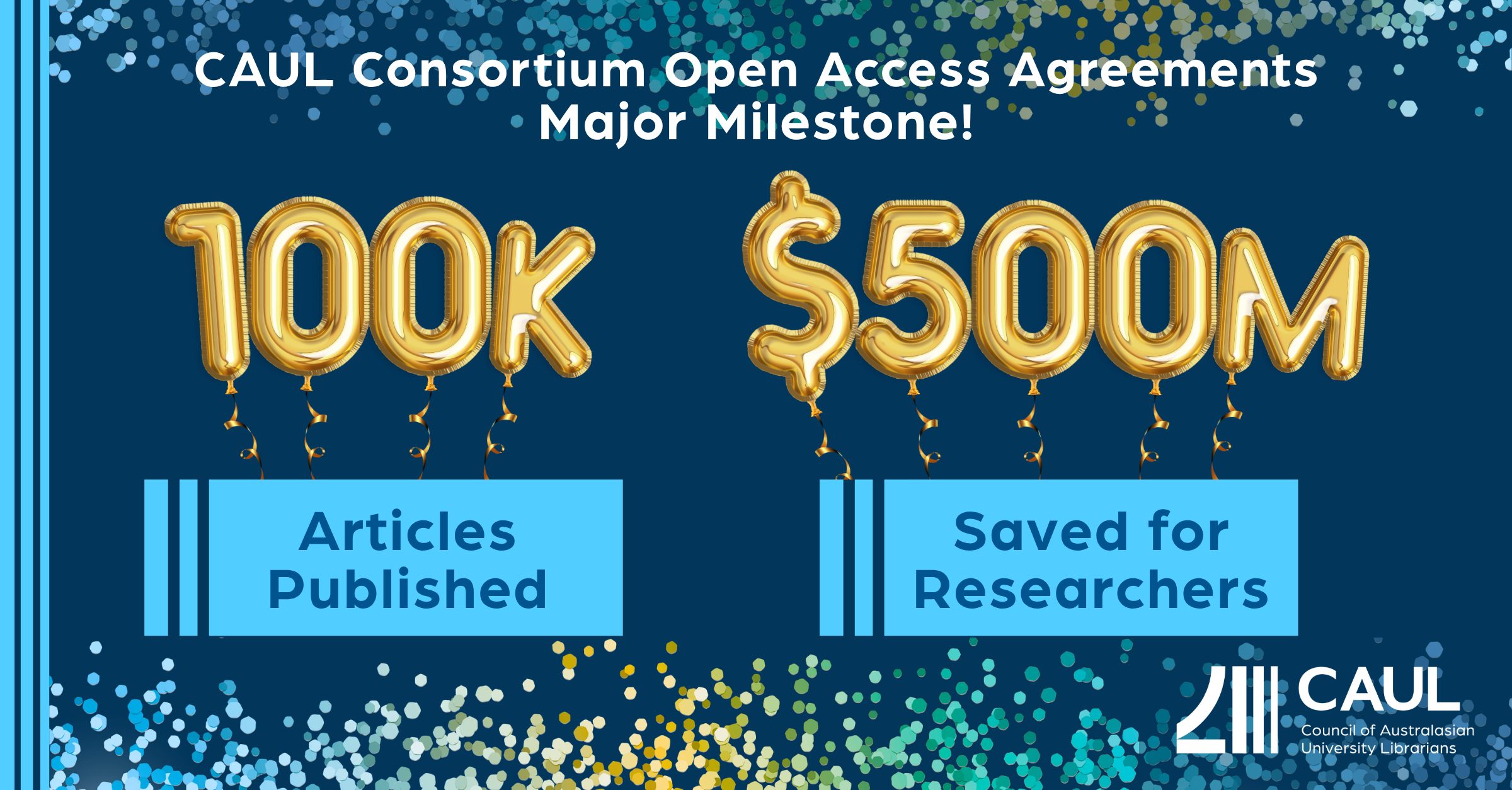
Today, CAUL announces an important milestone in Open Access publishing for Australia and Aotearoa New Zealand. Last week, the 100,000th Open Access article was published through a CAUL consortium agreement. CAUL first established Open Access agreements with two small publishers in 2020 and has since grown to include 26 publishers, ranging from small society publishers to the world’s largest academic platforms.
“It’s a wonderful privilege to be Chair of the CAUL Board at this milestone,” said Kylie Percival, University Librarian at Curtin University and Chair of the CAUL Board of Directors. “Hundreds of library staff, publishers, and the CAUL Office have been involved in making these agreements a success over the years – a real testament to what can be achieved across the sector when we all work together.”
The CAUL Open Access agreements which have leveraged library financial resources and expertise to implement, while containing costs for researchers, now exceed $500 million in article processing fees saved that would otherwise have been paid directly from university and researcher funds to publishers.
“Working in partnership with Universities Australia and Universities New Zealand, CAUL has fundamentally shifted the conversation with global publishers and secured sustainable pathways to open publishing that reduce both financial and administrative burden for researchers and institutions,” said Hero Macdonald, University Librarian at Deakin University and Chair of the CAUL Content Procurement Committee. “This impressive milestone reflects CAUL’s commitment to advancing a more equitable and sustainable scholarly communications system, and the impact that we have delivered for the sector.”
“100,000 articles demonstrates real benefit not only to our university community, but to all of society by making research freely accessible to everyone and not just those with library access,” said Jane Angel, CAUL CEO.
Through its 2026-28 strategic plan, CAUL continues to develop its Open Access programs to transform knowledge ecosystems for equity and access and extends its thanks to Members, publishers, and sector colleagues as it celebrates this significant achievement.